2011/08/19

Nara-Tokae


1300years ago,Nara was the capital of Japan.Every year on the site of the old capital is held an event which is called "Tokae".
This event started in 1999 and continues for 10days from the beginning until the middle of August.
Over 10,000candles are arranged all over Nara park,especially on the paths leading to big temples.


I especially liked the artistic shapes which had been laid out in the temple grounds,I saw "a heart""a deer face""lightning""Chinese characters "  for   "" means peace,love co-operation etc.
a heart

a deer face


lightning


Chinese character  和

It was very beautiful like a flower garden or fire flies in a dark forest.
The organizers,used the candles to symbolize people's prayers for peace and harmony all  over the world.

For 500yen you can buy a candle floating in a cup of water and place it as instructed by a guide,before lightning it yourself.The money raised goes towards next year's event.I thought it was a good idea to support the event in this way and I could join in the spirit of the event by offering a prayer for continued health and peace on this planet.


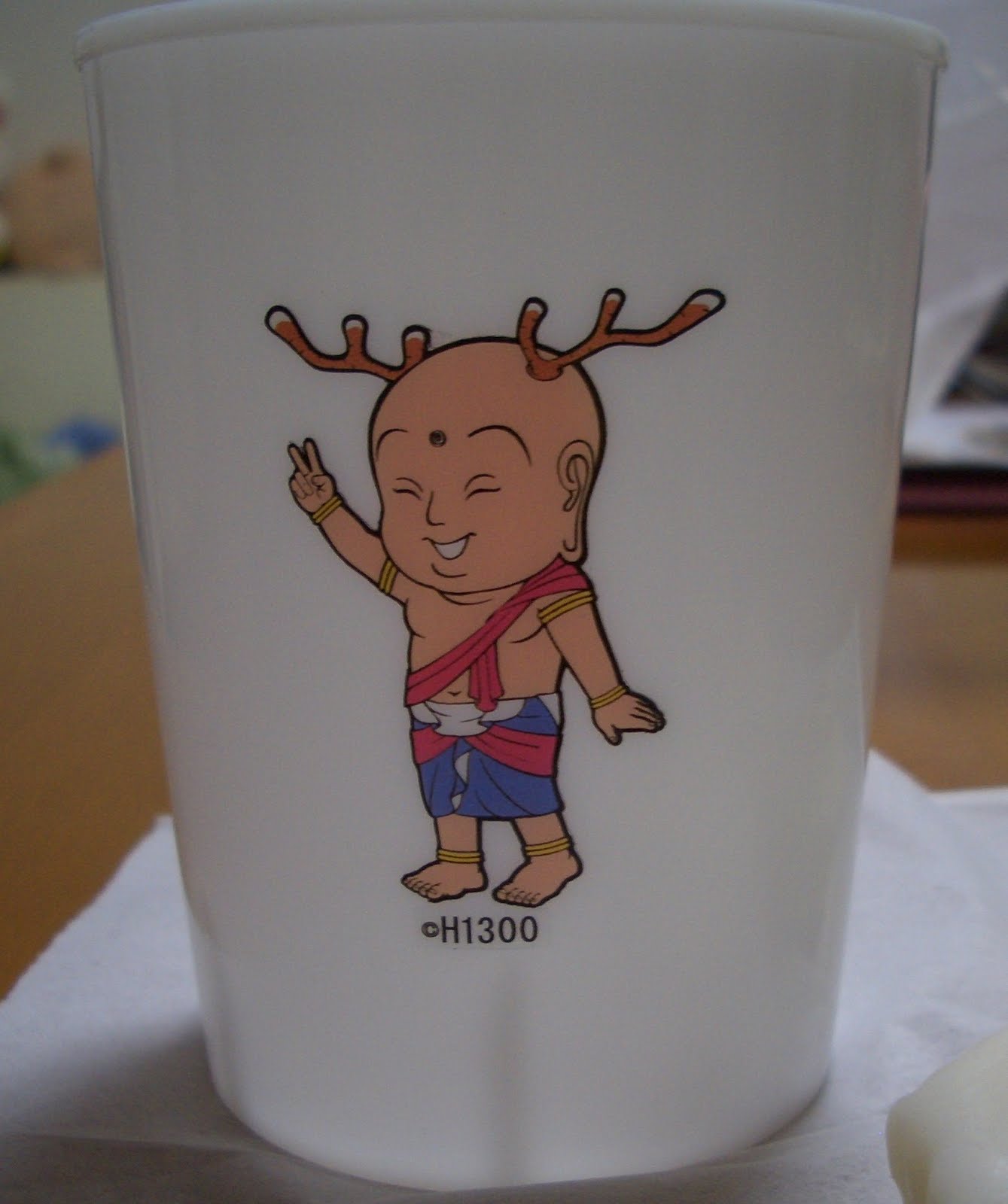
I found a souvenir shop and bought a candle with a special cup which has Nara's mascot "Sento-kun"printed on it."Sento-kun"appeared about 3years ago as the winner of a competition created by the prefectural government of Nara.He looks like the big Buddha of Todai-ji temple but he has deer's antlers on his head.


Sento-kun

2011/08/16

Service Area (S.A)


I love traveling by car in Japan.I usually use highways when I go areas other prefectures of Japan.
One of my greatest enjoyments is "Service Areas" which are regularly spaced along Japanese highways and  I guess not only me but most Japanese love stopping there too.


S.A's are one of the ways of dealing with Japanese highways which are usually crowded especially on weekends.
Motorists are encouraged to get off the highway and enjoy a stop over in S.As in this way the highways become less congested and the government lowned S.As are able to rake in more profits from the public...ingenious!!!

believe it or nor some S.As have rental beds,spas and aquariums.Of cource the main purpose of S.As for to provide traffic condition updates and toilet stops.


But, in recent decades,these services have been extended and now there are selling a huge variety of local foods and souvenirs(hand crafts,memorabilia etc.)


Usually there are a lot of restaurants in S.As as where we can taste local foods as well as the national favorites although they are never cheap.
There are some food courts which are cheeper but,always crowded.In the food courts customoers have to buy tickets in advance,using the automatic food ticket machines .
The most popular choices are "Ra-men""Domburi",tea is available you can drink free.


2011/08/07

Sumo in Nagoya


I went to Nagoya to watch sumo end of June,it was my first time to watch it.
Le me explain about sumo.

Sumo is a Japanese style of wrestling and Japan's national sport. It originated in  ancient times as a performance to entertain the Shinto daiety. Many rituals with religious background are still followed today.
The basic rules of sumo are simple: the wrestler who first touches the ground with anything besides the soles of his feet, or who leaves the ring before his opponent, loses. Fights take place on an elevated ring, called a "dohyo", which is made of clay and covered in a layer of sand. The fights themselves usually last only a few seconds, or in rare cases, about a minute.


At the top of the sumo wrestlers' hierarchy stand the yokozuna (grand champion). Once a wrestler reaches the rank of yokozuna, he cannot lose this status but he will be expected to retire when his results begin to worsen. Many former wrestlers remain active in the sumo world as members of the Japan Sumo Association.

Most elite wrestlers are highly trained athletes between 20 and 35 years old. They typically live together in residential and training complexes, called "stables", where all aspects of life, from sleeping and eating to training and free time, are strictly regimented by the coach, called the "stable master".
There are no weight restrictions or classes in sumo, meaning that wrestlers can easily find themselves matched off against someone many times their size. As a result, weight gain is an essential part of sumo training. The typical sumo dish, chanko nabe,(I wrote about it January 2011)  is a hearty stew full of vegetables, meat and fish.
Six tournaments are held every year, each one lasting 15 days. Three of the tournaments are held in  Tokyo (January, May, September), and one each in Osaka (March), Nagoya (July) and Fukuoka (November).


2011/07/21

Unagi


Today,being the 21st of July,is the most important unagi (eel) day in Japan.
In ancient times people in Japan used the koyomi (almanac) consisting of 12 animal characters (the Chinese lunar calendar) in those times,they used it for time as well as months and days. (ie) (the hour of tiger,ox,rabbit etc) We call those characters "eto",nowadays there are only a few vestiges of this ancient almanac in modern Japanese culture.
People still remaining their own Chinese zodiac character, we learn them at school the age of 10.

Anyway according to the koyomi , today is a "doyo-no-ushi" there are 5 or 6 such days a year and when people hear the word,almost everyone in Japan thinks of eating unagi (eel). It's part of food culture to eat eel on "doyo-no-ushi".

There is an old Japanese book written in 1822,which tells the story of dodgy eel merchants coming up with a scheme to sell a lot of eel on these days,especially in summer,when people tend to lose their appetite.According to the book,eel merchants consulted a scholar about their low sales in summer and possible means to combat this problem in their business.
Unagi is vitamin rich,it's effective for combatting "natsu-bate"(summer fatigue) and beginning with "U" it was suggested to promote it's benefit its on "doyo-no-ushi".


This morning I received a lot of fliers,in my daily newspapers.Every supermarket,convenience store,or restaurant tries to take advantage of this custom to promote sales of unagi on this day.Of course I ate unagi as my dinner.


2011/07/14

Katori-senko


I prefer winter to summer although in fact my favourite season is spring.
One of the reasons why I don't like summer is "mosquitoes" especially at night mosquitoes are terrible.Of course everyone knows the sound makes us annoying when we are trying to sleep.

I have "katori-senko" it is a kind of chemical product.I don't know exactly what its made from but it helps me to deal with "summer curse".
The main purpose of katori-senko is to kill and  repel mosquitoes by smoke.I usually put them near the balcony or the entrance,I feel better when I use it and I love the smell.It's totally different to aroma candles etc,but the smell reminds me of my grand mother's house.


Recently there are many products which kill mosquitoes but they need to have plugged into the power point.I tried some of these products but I think it's more natural and saves electricity to use katori-senko,so always went back to using them.

It's only been using them for two months but they have enabled me to deal with one uncomfortable aspect of summer in Japan.


2011/07/07

Tanabata

Tanabata, “the star festival”, is celebrated on 7th July every year in Japan even though it's not national holiday. 

Let me tell you a Tanabata story briefly.
A long time ago, the god of the sky, Ten-Ko  had a daughter called Orihime.   She wove clothes by machine.He worried about his daughter because Orihime worked very hard and did nothing but weaving clothes.Therefore, he introduced a man to her.  His name was Ken-Gyu. He was a cowherd. They fell in love very soon, and spent all of their time without working.  Eventually, every clothes became worn out, and all cows became sick because they didn't care.  Ten-ko got very angry and he had stopped to meet them each other until they restart to work.He made Amanogawa (Milky Way) which is a big river, so Orihime and Ken-Gyu was pulled apart by her father Ten-ko and they  felt sad very much.  Finally they go back their work and her father Ten-ko permitted to meet them only once a year 7th July, and they tried to work very hard to see each other.  

It said when the weather on 7th July is sunny,they can see each other but if it's rainy they can't see because of the river will be swell.Unfortunately today is rainy...


This morning I saw a flyer with a newspaper which was a  supermarket near by.The supermarket gets in on the act,which their many kinds of products are selling 77yen.(77yen comes from 7th July).
Cheap price is good for me!!!