ラベル culture の投稿を表示しています。 すべての投稿を表示

2011/08/19

Nara-Tokae


1300years ago,Nara was the capital of Japan.Every year on the site of the old capital is held an event which is called "Tokae".
This event started in 1999 and continues for 10days from the beginning until the middle of August.
Over 10,000candles are arranged all over Nara park,especially on the paths leading to big temples.


I especially liked the artistic shapes which had been laid out in the temple grounds,I saw "a heart""a deer face""lightning""Chinese characters "  for   "" means peace,love co-operation etc.
a heart

a deer face


lightning


Chinese character  和

It was very beautiful like a flower garden or fire flies in a dark forest.
The organizers,used the candles to symbolize people's prayers for peace and harmony all  over the world.

For 500yen you can buy a candle floating in a cup of water and place it as instructed by a guide,before lightning it yourself.The money raised goes towards next year's event.I thought it was a good idea to support the event in this way and I could join in the spirit of the event by offering a prayer for continued health and peace on this planet.


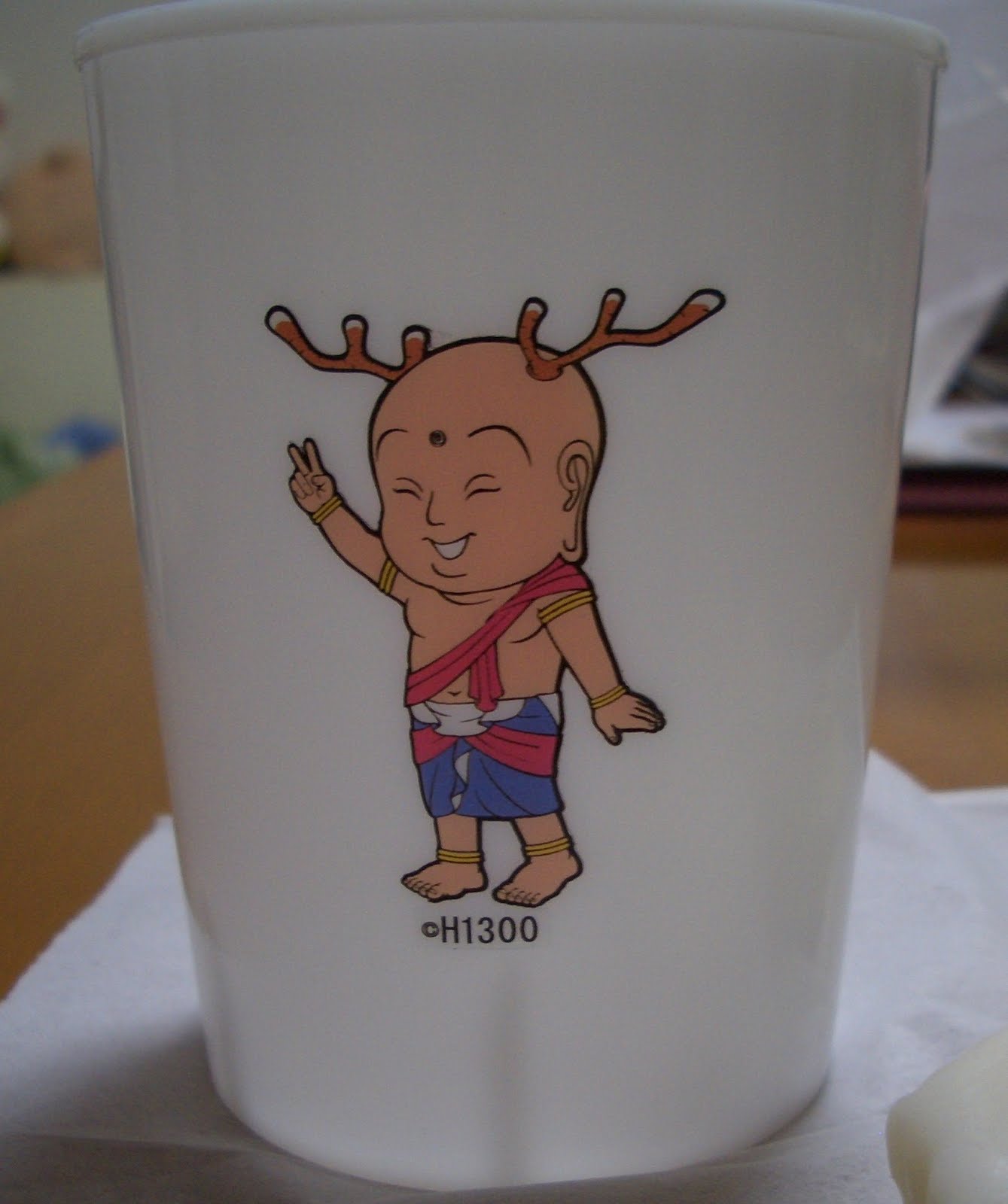
I found a souvenir shop and bought a candle with a special cup which has Nara's mascot "Sento-kun"printed on it."Sento-kun"appeared about 3years ago as the winner of a competition created by the prefectural government of Nara.He looks like the big Buddha of Todai-ji temple but he has deer's antlers on his head.


Sento-kun

2011/08/07

Sumo in Nagoya


I went to Nagoya to watch sumo end of June,it was my first time to watch it.
Le me explain about sumo.

Sumo is a Japanese style of wrestling and Japan's national sport. It originated in  ancient times as a performance to entertain the Shinto daiety. Many rituals with religious background are still followed today.
The basic rules of sumo are simple: the wrestler who first touches the ground with anything besides the soles of his feet, or who leaves the ring before his opponent, loses. Fights take place on an elevated ring, called a "dohyo", which is made of clay and covered in a layer of sand. The fights themselves usually last only a few seconds, or in rare cases, about a minute.


At the top of the sumo wrestlers' hierarchy stand the yokozuna (grand champion). Once a wrestler reaches the rank of yokozuna, he cannot lose this status but he will be expected to retire when his results begin to worsen. Many former wrestlers remain active in the sumo world as members of the Japan Sumo Association.

Most elite wrestlers are highly trained athletes between 20 and 35 years old. They typically live together in residential and training complexes, called "stables", where all aspects of life, from sleeping and eating to training and free time, are strictly regimented by the coach, called the "stable master".
There are no weight restrictions or classes in sumo, meaning that wrestlers can easily find themselves matched off against someone many times their size. As a result, weight gain is an essential part of sumo training. The typical sumo dish, chanko nabe,(I wrote about it January 2011)  is a hearty stew full of vegetables, meat and fish.
Six tournaments are held every year, each one lasting 15 days. Three of the tournaments are held in  Tokyo (January, May, September), and one each in Osaka (March), Nagoya (July) and Fukuoka (November).